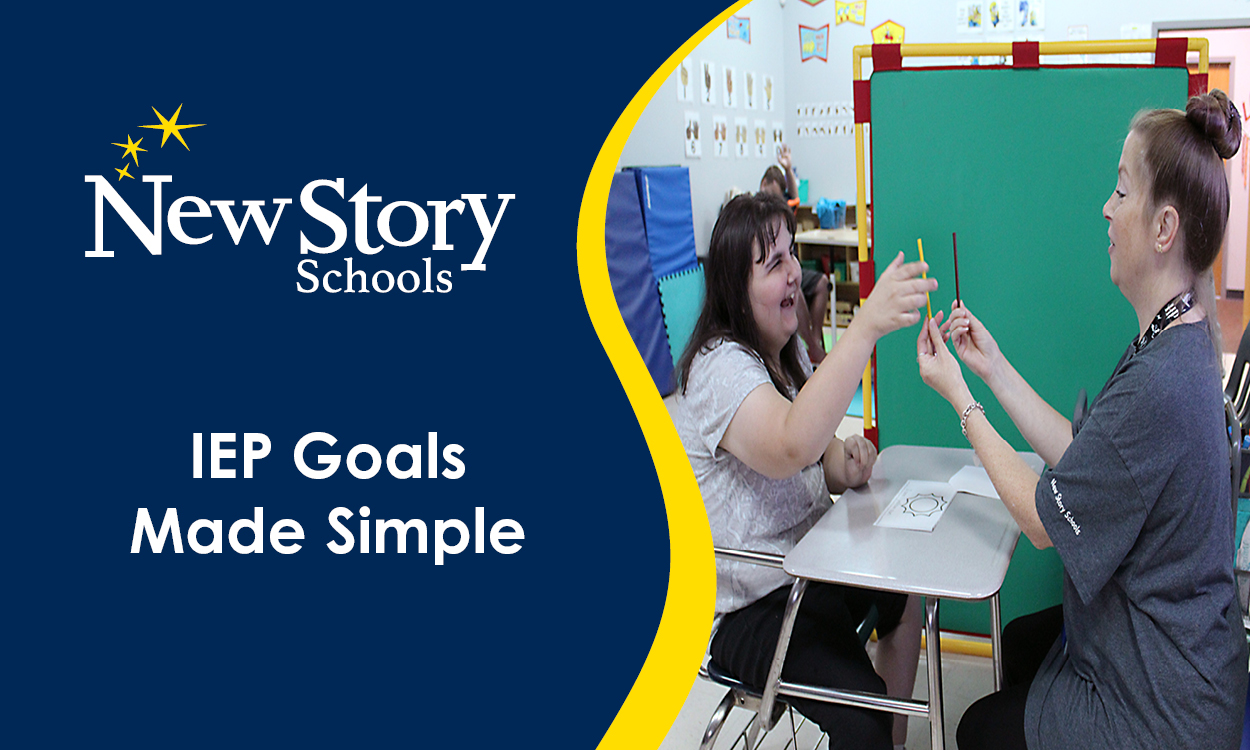
IEP Goals Made Simple
Posted: April 22, 2026 | Written By: Drew Delligatti | Category:
Whether you’re a parent or a special education teacher, understanding what makes a proper Individualized Education Plan (IEP) goal can be a challenge. This guide breaks down the basics in plain language and shares practical examples of goals that support real progress at school.
What Does an IEP Goal Look Like?
Under the Individuals with Disabilities Education Act (IDEA), an IEP must include measurable annual goals, how your student’s progress toward those goals will be measured, and when progress updates will be distributed (for example, quarterly or with report cards).
In plain terms, a strong IEP goal should state what skill your student will work on, what it will look like when they do it, how the team will track it (like a checklist, rubric, or data counts), and what success looks like by the end of the IEP year, so everyone can see progress instead of guessing.
How to Set a Goal
A simple formula to help create a strong IEP goal is the SMART approach: Specific, Measurable, Action-oriented, Relevant, Time-bound.
- Specific: The goal should describe one clear skill, not a broad hope. If someone reading the goal cannot picture what the student is expected to do, it is probably too general.
- Measurable: The goal should include a way to track progress with data, so the team can tell whether the support plan is working. This prevents goals from being based on impressions.
- Action-oriented: The goal should use a verb that describes something observable, meaning a teacher could see or hear it happen. Words like “understand” can be too vague to measure, so teams often use verbs like “identify,” “request,” “complete,” “begin,” or “use.”
- Relevant: The goal should be achievable for the student within a year and directly connected to what is getting in the way of learning or participation. It should also match the student’s current starting point rather than setting unrealistic expectations.
- Time-bound: The goal should have a clear timeframe for review, usually by the end of the IEP year, and it should be measured often enough that the team can adjust supports if progress is not happening.
A strong goal usually includes:
Setting and Supports: This describes the situation when the child is expected to use the skill during the day. It also explains what supports will be used to help them in using the skill.
Example: During challenging tasks, with permission to request a break and access to a calm space for up to 5 minutes
Observable Skill: This is the specific action a student is expected to start using. It should be something that someone can clearly see or hear.
Example: The student will request a break using a taught phrase, card, or signal, use the calm space, then return to the task.
Measurement Method: This explains how the team will collect data to determine how effective the supports are.
Example: Staff will track each opportunity using a tally sheet: (1) break requested appropriately, (2) time in calm space, (3) returned to task.
Criteria: This is the “success line” and the timeline. It defines what level counts as meeting the goal and by what date.
Example: In 4 out of 5 challenging-task opportunities, the student will request a break appropriately and return to the task within 7 minutes total (5-minute break + 2-minute re-entry), for 3 consecutive weeks.
Here are some examples of strong IEP goals:
Break plan: During instruction, when the student shows early signs of escalation, the student will request a break using a taught phrase and return to task within 5 minutes in 80% of opportunities, measured weekly.
Peer interaction: In structured group activities, the student will initiate or respond to a peer with one on-topic comment or question in 3 of 4 sessions, measured by a simple rubric.
Organization and follow-through: Using a planner or digital system, the student will record assignments and submit work by the due date for 80% of assignments for each marking period, measured through assignment data.
Confused on the difference between an IEP and a 504? Check out this blog to learn more!
Want to be notified of new articles and resources from New Story Schools? Submit your email and opt into our newsletter!